Environmental Eco News Browser - EcoTopical - Environmental News

 
  • The Beaver Lake Cree Judgment: The Most Important Tar Sands Case You’ve Never Heard Of

    24 May 2013, 4:30 pm by: Carol Linnitt
    Sure they’re bad for the environment, for human health, and for wildlife, but we rarely stop to wonder if the Alberta tar sands are in fact unconstitutional. But the constitutional standing of the tar sands – one of the world’s largest and most...

    Sure they’re bad for the environment, for human health, and for wildlife, but we rarely stop to wonder if the Alberta tar sands are in fact unconstitutional.

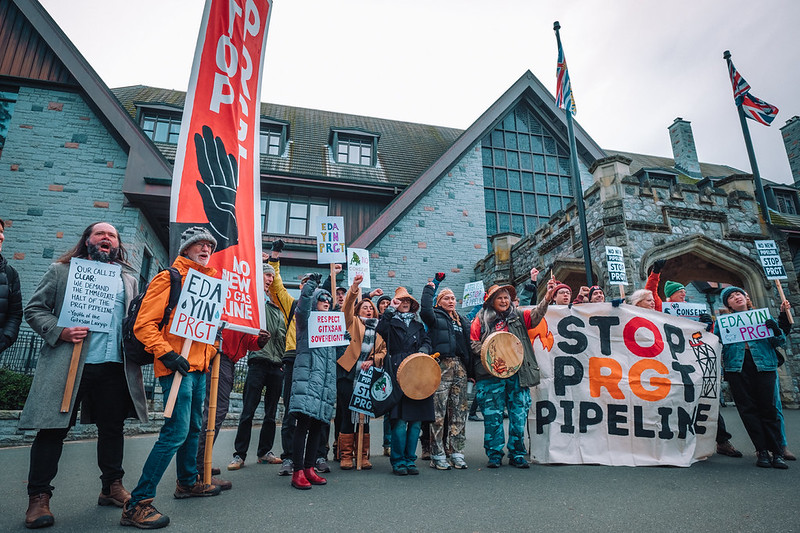
    But the constitutional standing of the tar sands – one of the world’s largest and most carbon-intensive energy projects – is just what’s at stake in a treaty rights claim the Beaver Lake Cree Nation (BLCN) is bringing against the Governments of Alberta and Canada in a case that promises to be one of the most significant legal and constitutional challenges to the megaproject seen in Canada to date.

    Signaling the high-stakes of the whole dispute, it has taken five years of beleaguered fighting just to have the case go to trial. Canada and Alberta – the defendants – fought tooth and nail during those five years to have the claim dismissed outright, saying the case put forward by the BCLN was “frivolous, improper and an abuse of process.”

    The BCLN is challenging these governments on the grounds of the cumulative impacts of the tar sands and has indicated some 19,000 ‘individual authorizations’ and 300 individual industrial projects in their claim. The governments of Alberta and Canada tried to have the case dismissed under Rule 3.68, a measure meant to protect defendants from cases that are…well…“frivolous, improper, and an abuse of process.”

    But this case isn’t one of those.

    Canada claimed the claim was “unmanageable” and “overwhelming,” suggesting the 19,000 authorizations were likely to have fallen within the relevant regulatory framework at the time of their approval and needn't be bothered with. But, as one judge stated, a claim cannot be dismissed based merely on its scope. The courts agreed, telling Canada that no further “delaying tactics” should be permitted in this litigation lest the entire claim be “stonewalled at an early stage through excessive particularization.”

    What is more, the court said Canada’s complaint “flies in the face of the Supreme Court of Canada” and its previous decisions, indicating Canada’s counsel was unsuccessful in its attempts to squeeze out of a tight legal position. Canada even sought to have its portion of the claim whittled down to “limit its exposure” in the case, a position the court said Canada’s “counsel candidly admitted to advancing…for strategic reasons.”

    On April 30th, 2013, the courts told Canada and Alberta they’d had enough of the bickering. “The parties will be well-served by returning to their case management judge for the implication plan to advance this litigation through trial,” they wrote.

    In other words: get your act together, you’re going to court.

    The Rights

    The Alberta Court of Appeal’s decision to uphold the claim against the crown, grants the BLCN the opportunity to argue the cumulative negative impacts of tar sands expansion may constitute a legal breach of the band’s historic Treaty 6 with the Canadian government, signed back in 1876.

    And the significance of this judgment cannot be overstated. The BLCN’s claim now stands as the first opportunity for legal consideration of the cumulative impacts of the tar sands on First Nation’s traditional territory and the implications of those impacts on the ability to uphold Treaty Rights.

    And First Nation’s Rights – enshrined as Aboriginal Rights in section 35 of the Constitution Act, 1982 – are arguably some of the most important emerging rights on the Canadian legal landscape and certainly the most powerful environmental rights in the country.

    This, in part, has to do with the fact that what section 35 rights actually legally entail, is still being developed through case law. Dozens of important cases - like the precedent-setting R v. Gladstone and Mikisew v. Canada- have been decided by courts over the last 30 years, since the patriation of the Constitution, finding Canada in serious violation of the Constitution when it comes to treaty rights.

    Despite the emerging nature of these rights, one thing is clear – First Nations have the inalienable right to hunt, trap and fish in their preferred manner, throughout their traditional territories and the province.

    And there’s the rub. If you’ve got a megaproject that is destroying what you might otherwise be hunting, trapping or fishing, you've got a serious constitutional gaffe on your hands. The Constitution is the highest law in the land, and cannot simply be ignored.

    The Cumulative Impacts

    This puts Canada and Alberta in a tough spot. Over the last decade, as they’ve been welcoming a veritable cascade of new projects in the tar sands area, scientists and conservation groups have been raising the alarm as the consequent research began to show devastating effects on caribou populations and fish species especially hard done by the escalating development.

    The BCLN’s traditional territories blanket an area about the size of Switzerland. Thirty per cent of tar sands production, or about 560,000 barrels of oil, are produced on BLCN every day. The oil industry has plans to grow this number to 1.6 million barrels a day.

    The once-pristine forest and hunting grounds are now covered with 35,000 oil and gas sites, 21,700 kilometres of seismic lines, 4,028 kilometres of pipeline and 948 kilometres of road.

    Perhaps it has taken Canada and Alberta by surprise that the cumulative impacts might be considered at a constitutional level. After all, neither the province nor the federal government have been particularly proactive in studying the cumulative effects of development in the area.

    True, scientists have been fretting about loss of caribou herds and habitat for decades, even citing the Species At Risk Act as a potential legal cause to slow the pace and scale of tar sands development. But Canada ignored those pleas for caution as long at it could – until another legal action forced them to release the recent Federal Caribou Recovery Act last fall.

    And it was only a few months ago that Environment Canada scientists announced tar sands pollution was present in bodies of water up to 100 kilometres from the centre of development. The accumulating toxins, they discovered, disrupt fish embryos at the developmental stage. The federal government worked overtime to downplay the significance of the research last fall, even preventing lead researchers from discussing their findings with the media.

    Overall, the federal government has been just as culpable as provincial leaders in keeping these growing environmental effects under-reported, or under wraps. The BLCN’s upcoming litigation may be the change in tide that brings the cumulative impact discussion to centre-stage.

    The Cause for Hope

    5 years ago Crystal Lameman’s uncle Chief Al Lameman filed the original claim on behalf of the Nation.

    “In 2008 I don't think my uncle knew the attention this litigation would gain,” Crystal said. “His intent and purpose was to protect what little we have left but it has created this movement, this mobilization of a people and it's a great feeling seeing people mobilize beyond the confines of race, color, and creed. This recent win means our judicial system is clearly standing strong in the law of Canada and it gives me hope.” 

    And Crystal has much cause for hope, according to Jack Woodward, renowned Native Law expert and lawyer on the case.

    “The Beaver Lake case will define the point where industrial development must be curtailed to preserve treaty rights,” he said.

    “At issue is the cumulative impact of industry, not each individual project. The court will be asked to say if the level of industrial activity in the hunting grounds has now crossed the line to make it impossible to reasonably exercise the harvesting rights. If the Beaver Lake are successful there will be constitutional controls on development to allow the land to recover and to prevent any further encroachments that might disturb wildlife populations.”

    A precedent-setting ruling of that sort would have significance for any other First Nation making similar claims regarding the overall impacts of industrial development. This could have serious ramifications for other First Nation groups living near the tar sands or newly-industrialized zones like British Columbia’s northeast.

    “This would be the most powerful ecological precedent ever set in a Canadian court,” says Woodward, “because it protects the entire biological system with a view to preserving its sustainable productivity.”

    Other legal protections like the Fisheries Act or the Species at Risk Act, he says, amount to a “piece by piece approach.” The Beaver Lake Cree litigation “is based on protection of the entire ecosystem,” he adds, and determining that crucial point when that system “can’t take it anymore.”

    “So the precedent that will be set by the Beaver Lake case is that it will be the first time a court is asked to draw the line defining too much industrial development in the face of constitutionally protected treaty rights.”  

    The Battle Ensues

    Susan Smitten of Respecting Aboriginal Values and Environmental Needs (RAVEN), a non-profit group supporting the BCLN action since 2009, says just getting the case to trial has been tremendously difficult and expensive.

    But the very importance of the case has brought help from all directions.

    “We have raised something like $850,000 for the BLCN to cover costs,” she said, “plus we found pro bono lawyers from the UK to assist with the first round on the motion to strike.” People donated, lawyers worked at half-rate, and volunteers gave their time, all to keep the possibility of reaching trial alive.

    “Canada and Alberta have done absolutely everything they can to delay and outspend” the BLCN, says Smitten. “This is particularly disappointing with respect to our federal government, which one would hope might support First Nations rights, and honour the promises made.”

    However, she says, the tactics of perpetual delay are common practice when it comes to First Nations’ disputes. The government hopes the problem will fade away “because the band can’t keep up with the costs,” she adds.

    Smitten estimates the costs could skyrocket up to $15 million once all is said and done.

    “With this win, I hope everyone sees the value in assisting this band – morally, financially, emotionally, physically. This is doable. It’s going to trial.”

    “I’m always so impressed and astounded that [the BLCN] stay with it,” Smitten said. “The energy it takes to keep this moving forward is incredible.”

    The trail represent more than the preservation of First Nation rights and territory, to Smitten. The threat of climate change, she says, is something we all face collectively. Yet, average Canadians don’t have the special constitutional status of First Nations.

    “Our Aboriginal peoples will be the ones that rescue Canada from the worst effects of the tar sands,” says Smitten.

    “But it’s not fair to rely on the poorest people in our nation to stand alone and be the voice of reason in this effort. They have the power of their treaties to protect the planet, and we have the power of a nation to support them. I just encourage people to get behind the line they’ve figuratively and literally drawn in the tar sand.” 

    Lead image credit: Chief Al Lameman via The Co-Operative

  • Is Houston a Tar Sands “Sacrifice Zone”?

    24 May 2013, 8:00 am by: Guest
    This is a guest post by Caroline Selle Much of the debate around the Keystone XL pipeline has focused on the dangers of extracting and transporting the tar sands. Left out, however, are those in the United States who are guaranteed to feel the impac...

    This is a guest post by Caroline Selle

    Much of the debate around the Keystone XL pipeline has focused on the dangers of extracting and transporting the tar sands. Left out, however, are those in the United States who are
    guaranteed to feel the impacts of increased tar sands usage. Spill or no spill, anyone living near a tar sands refinery will bear the burden of the refining process.

    Tar sands oil is produced from a mixture of sand, clay, water, and the sticky, peanut-butter like form of petroleum known as bitumen. Unlike conventional crude, it’s essentially solid at room temperature, has a higher heavy metal content, and has to be diluted for transport. The diluents are trade secrets, and the content mixture - which often contains benzene, a human carcinogen - isn’t something companies are required to report.

    DeSmogBlog has covered the impacts of tar sands extraction on indigenous communities, and the dangers of moving tar sands through a network of pipelines is aptly covered here. And while major nonprofits have completed studies on the dangers of transporting tar sands, there is significantly less information available on how refining tar sands differs from processing conventional crude.

    Additional heavy metals and benzene might sound like a recipe for disaster anywhere, but the location of several major tar sands refineries is already overburdened with pollutants. In Harris County, Texas – home to the city of Houston – people are already surrounded by refineries and factories spewing toxic pollution into the air. And as the southern leg of the Keystone XL project slowly fills in its missing pieces, the spectre of toxic bitumen looms.

    Harris County, Texas, is home to the Lyondell Houston Refinery. The Lyondell facility is expanding its ability to refine tar sands bitumen, attempting to more than double its capacity to process Canadian crude. Never mind that the refinery already has numerous Clean Air and Clean Water Act violations. If the facility expands as planned, its capacity will increase from 60,000 to 175,000 barrels a day.

    The air quality in Harris County is already dangerous without the added burden of tar sands pollution. Although levels of many chemicals have decreased in recent years, residents are reaping the rewards of living so close to massive amounts of cancer-causing pollution. A 2006 study by the Texas government found increased rates of certain cancers in the Harris County population.

    Children living in the areas with the highest level of 1,3 butadiene had a 153% higher chance of developing acute myeloid leukemia than those living in areas with the lowest concentrations of the same chemical. A 2003 study found a positive correlation between ozone density and asthma in Harris County residents, and the cancer risk of Houston residents living in the most contaminated areas is increased by a factor of 1000.

    Though the Lyondell website advertises winning “13 national safety awards in the past five years,” the Lyondell Chemical Co. has the second highest rate of disposing of toxics of any industrial facility in Harris County. The more you learn, the worse it gets. In 2011, Harris County accounts for 14.74 percent of total Toxic Release Inventory (TRI) measured chemical releases and transfers in Texas. Texas already ranks 3rd highest (worst) in terms of pounds of toxics released and or transferred  - out of 56 states and territories.

    Lyondell Chemical Co. owns Houston Refining, a facility in Manchester, Texas which has been the subject of four formal EPA enforcement acts in the last five years. The company was fined $549,055 for violating the Clean Air Act, and yet, as of April, 2013, the facility has had 12 consecutive quarters of non-compliance. The area around Houston refining is 80% minority, with about one out of every four people below the federal poverty line.

    Despite these grim statistics, the refinery was granted a pollution permit from the Texas Council on Environmental Quality without the requested public hearing in 2010. Residents were concerned about benzene exposure, which is likely to increase with greater refining of the tar sands. Already, the neighborhood has seen struggles over controlling the amount of benzene in the air.

    A 2011 report by the Texas Center for Environmental Quality revealed decreasing levels of toxics in the air, but some residents claim that the data is based off of faulty and broken air quality monitors. Still, the decreasing levels are likely unsafe: Texas has some of the highest ‘safe’ benchmarks for carcinogens in the country. Additionally, the cumulative effect of lifetime exposure to a “toxic soup” of “safe” levels of chemicals is unknown.

    With toxic chemical exposure nearly certain, it is unclear what the next step will be for residents of Harris County. It’s clear the area isn’t facing the impacts of the Keystone XL on the same timeline as the rest of the nation. President Obama already approved the lower leg of the pipeline, and the connection from Cushing, OK to Port Arthur, TX is almost complete.

    Once built, the Cushing hub will connect to other pipelines and transportation systems moving tar sands from Alberta. For many residents of Harris County, this is a life or death struggle more immediate than the “what-if” of a pipeline spill. And it’s not a “what-if.” For Harris County, the fight is “right now.”

    Image credit: Oil Refinery on Shutterstock

  • Harper Government Keeps Details Of $16.5M Oil Industry Ad Campaign Under Wraps

    23 May 2013, 11:00 am by: Indra Das
    This week, under questioning from opposition MPs, Natural Resources Minister Joe Oliver confirmed that his department intends to spend up to 16.5 million dollars on advertising in the upcoming year. Further details on how this taxpayer-funded PR camp...
    Natural Resources Minister Joe Oliver

    This week, under questioning from opposition MPs, Natural Resources Minister Joe Oliver confirmed that his department intends to spend up to 16.5 million dollars on advertising in the upcoming year. Further details on how this taxpayer-funded PR campaign for Canada's natural resources will be run were lacking.

    Mike De Souza writes for Canada.com, that Oliver "also declined to provide specifics on a training program, worth up to $500,000, for his department's scientists and other officials, 'designed to help them communicate with the public and to do so in a way that is accessible to the public.'"

    Speaking to a special committee studying spending estimates in the House of Commons on Tuesday evening, Oliver confirmed that much of the advertising would be focused on promoting the proposed TransCanada Keystone XL pipeline linking Albertan tar sands oil to refineries on the Texas Gulf Coast.

    This comes as no surprise, with Prime Minister Stephen Harper trumpeting the multibillion dollar Keystone project's virtues in the US, and his government fighting an EU initiative to label tar sands oil as highly polluting. As De Souza writes, "Canadian and American oil companies are lobbying the Obama government to approve the pipeline in order to support oilsands expansion and jobs."

    Oliver reportedly declined to say how much money was being spent in the US and Europe for aforementioned lobbying against climate-change legislation. He "also declined to say whether any advertising money would be spent to promote renewable energy sources such as wind and solar power."

    Opposition MPs didn't take kindly to the plan. NDP natural resources critic Peter Julian apparently denounced it as "political advertising," saying that it represents a 7,000 per cent increase in advertising budgets at Natural Resources Canada since 2010-2011. Julian also expressed concerns about the initiative to train scientists on public speaking, especially with the government already under scrutiny for preventing scientists from speaking about research on climate change.

    De Souza quotes Julian as saying, "The idea that there would be some kind of formal media muzzling of scientists is something that most Canadians would profoundly disagree with." He took issue with funnelling taxpayers' money into this kind of "media muzzling."

    Liberal Marc Garneau also called the promotion of tar sands oil development "irresponsible" when the government still doesn't have concrete answers on the potential impact of tar sands crude spills in the Pacific Ocean. That such spills could have long-term repercussions is clear. For example, the Environmental Protection Agency (EPA) recently issued an order to Enbridge asking them to clean up lingering pollution from a 2010 pipeline spill in Michigan.

    When asked about the results of research into the issue, Oliver said that there's no way for him to "know what the precise results of that research would be."

    Oliver acknowledged that "climate change is a pressing global problem," but added that the "nature of our policy response is different from that of the opposition parties." One presumes the Harper government's "policy response" is to channel its resources into promoting the very industry that contributes so heavily to this "pressing global problem."

    De Souza adds that Natural Resources Canada "emailed Postmedia News explaining that details of the $16.5 million in advertising would be published at some point in the future. It also said that the special training program for scientists and staff was required under the government's public relations policy and that the program's budget would not exceed $400,000 at Natural Resources Canada."

    Image Credit: Government of Canada / Wikimedia Commons

  • FOIA Facts 4 - George Mason Takes The Money And Breaks The Rules

    23 May 2013, 8:30 am by: John Mashey
    New Freedom of Information Act (FOIA) replies (1, 2, and 3) expose worse misbehavior at George Mason University. GMU badly mishandled simple plagiarism complaints, including one on a Federally-funded paper, retracted in May 2011, finally ruled as mis...

    New Freedom of Information Act (FOIA) replies (1, 2, and 3) expose worse misbehavior at George Mason University. GMU badly mishandled simple plagiarism complaints, including one on a Federally-funded paper, retracted in May 2011, finally ruled as misconduct in 2012. Federal rules required notifications to several agencies earlier, but FOIA requests found no trace of any: Army 1, Army 2, GMU 1, GMU 2.

    GMU gets $129M+/year in Federal grant funds, generally takes 30% for itself, but breaks rules.

    A Nature editorial criticized GMU's handling, the Chronicle of Higher Education covered the retraction, Science discussed the process. USA Today's Dan Vergano later wrote in February 2012:

    ''"We took these charges very seriously," (GMU Provost Peter) Stearns said, in a telephone interview, adding that the university will forward the investigation reports to federal authorities. The National Institutes of Health and the Department of the Army supported the 2008 study.'

    Stearns had already written falsehoods to his own faculty, as detailed in See No Evil, Speak Little Truth, Break Rules, Blame Others, §6. GMU has many respectable faculty members, but the GMU administration ran a bizarre process far outside academic norms, GMU's own rules and Federal rules.

    Was this just total incompetence by the administration of a 32,000-student university? Or was some part played by the powerful influence at GMU of Charles Koch and his associates, as discussed in See No Evil §A.5, §A.6?

    In any case, Edward Wegman was appointed in Fall 2012 to a 3-year term on the GMU College of Science Promotion and Tenure Committee.

    Then, in February 2013 GMU modified its already-opaque and complaint-discouraging process to be even more so.

    No Lack of Contradictory Rulings

    In December 2009, Canadian blogger “Deep Climate” started documenting problems in the Wegman Report.  Based on those findings, in March and May 2010, Raymond Bradley lodged formal plagiarism complaints to GMU for:

    1. 2.5 pages of the Wegman Report's text, taken from Bradley’s own book, ruled by GMU as not plagiarism, despite comments from experts.
    2. 5.5p Social Networks Analysis (SNA) in the Wegman Report, also ruled not plagiarism.
    3. 1.5p subset of that same SNA text re-used in a paper (P179 here) funded by 3 Federal grants.  Elsevier forced retraction in May 2011, GMU admitted to plagiarism in February 2012.   It seems hard to have done otherwise.


    Result 2 obviously contradicted 3. Stearns' February 2012 letter claimed existence of separate committees to handle 1+2, and 3 and claimed separate reports.  Earlier FOIAs proved both false.  GMU refused to release any reports, so we only have Stearns' word for their contents.

    No Notifications

    Dan Vergano talked to an expert and wrote:

    'Yes, plagiarism does matter," says scientific misconduct expert Nicholas Steneck of the University of Michigan, a former Office of Research Integrity official, by e-mail. Plagiarism is one of the "Big Three" of science misconduct offenses, alongside falsifying and fabricating data that trigger punishment from federal research agencies. "If the project is federally funded, the results of the investigation must be forwarded to the appropriate agency," Steneck says.'

    From  "See No Evil ... §1.2" GMU should have notified both Army Research Office (ARO)  and Office of Research Integrity (ORI, for National Institute on Alcohol Abuse and Alcoholism (NIAAA)) at steps 3-5:

    1. ~05/13/10 Bradley lodges complaint on Federally-funded paper
    2. ~09/30/10 Inquiry committee report recommended investigation
    3. ~03/07/11 GMU finally decided an investigation was warranted,
    4. ~10/11/11 GMU investigation was completed
    5. ~02/22/12 GMU completed adjudication


    FOIAs found nothing from ARO or GMU. While it is possible that both missed notifications,the ARO FOIA staff were especially diligent in tracking down other nontrivial requests. ORI was not asked, because they never comment on open cases.

    It is hard to prove non-existence, but the evidence is consistent - GMU failed to notify both agencies, despite Stearns' claim and the media spotlight. 

    Should GMU show that they did send notifications, I will be glad to retract these comments ... and send new FOIA requests for them.

    No Due Diligence

    GMU clearly failed to to perform the due diligence demanded by its own policies. It takes but a few minutes' perusal of the grant reports, especially of 0447, to notice at least some of the serious funds misuses detailed in FOIA Facts 2, starting with the Wegman Report. Vergano wrote:

    'Although a number of reports by Columbia University statistician Andrew Gelman and others have noted more instances of possible plagiarism in work by Wegman and his team, Stearns says the university is not investigating any other complaints.'

    In hopes that the new GMU President Angel Cabrera might take action, he was sent email citing See No Evil... in August 2012 and a similar certified letter in September. These attempts got no acknowledgement, but that omission inspired the latest FOIAs. Although intended to unearth GMU notifications, as a byproduct they happened to expose the pervasive funds misuse and other problems highlighted in this series.

    In 2011, GMU got $129M in Federal funds.

    Policies Change, But Not For The Better

    The old policy applied through February 21, 2013. Many schools specify that legitimate complainants be given reports, even informed of committee members, given appeal rights, etc.

    The new policy was signed by Associate VP Elizabeth Brock and Provost Stearns:

    "‘Confidentiality …

    The University reserves the right to communicate general information regarding the results of any proceedings, where necessary in the judgment of the administration to preserve or restore the reputation of the University, the respondent, or the complainant.  At no time, however, shall the University reveal detailed personal information regarding the complainant, the respondent or witnesses, nor shall the University reveal the nature or substance of the evidence or reasoning employed throughout the proceedings."

    This is even more explicit than the old one - GMU will tell nobody anything meaningful. The new procedure mostly resembles the old one, but with some different roles. 

    Perhaps encouraging, GMU now has an AVP - Assistant VP, Office of Research Integrity and Assurance, a job filled by an experienced person new to GMU. Peter Stearns is still Provost, although Roger Stough appears no longer to be VP Research and Economic Development.

    Having studied dozens of university policies and procedures, GMU's new one remains one of the most opaque and hostile to external complaints, that I have seen. It is unclear if anything important will really change, and of course:

    Wegman was appointed in Fall 2012 to a 3-year term on the GMU College of Science Promotion and Tenure Committee. 

    Thus, he will continue to have influence over younger faculty.

    Image Credit: Sam72 / Shutterstock.

  • IRS Sleuths Were on the Right Track: Big Tobacco Created Tea Party in 1994

    22 May 2013, 6:10 pm by: Guest
    This is a guest post by Pam Martens, cross-posted with permission from Wall Street On Parade. On February 25, 2013, James Hepburn, writing at Daily Kos, made the emphatic assertion in a headline that “Big Tobacco Had Nothing to Do With Tea Party Fo...

    This is a guest post by Pam Martens, cross-posted with permission from Wall Street On Parade.

    On February 25, 2013, James Hepburn, writing at Daily Kos, made the emphatic assertion in a headline that “Big Tobacco Had Nothing to Do With Tea Party Formation.” That is likely to be the one headline that will haunt Mr. Hepburn to his grave. 

    I decided to follow in the treacherous footsteps of the IRS and engaged in that unforgiveable sin: I targeted the “tea party” as a key word search at the legacy tobacco document archive.  Resting quietly in the archive is full blown proof that Big Tobaccodirectly created multiple Tea Parties in 1994 as push back against a planned increase in the Federal Excise Tax (FET) on cigarettes.  

    In fact, Big Tobacco not only created the Tea Party, it has promoted it over decades, pumped millions into marketing it, and pulled it out of its magic hat every time it needed to produce an overnight, spontaneous “grassroots” movement. 

    Hepburn was nit-picking an article at Huffington Post by Brendan DeMelle that characterized an exhaustive study by researchers at the University of California, San Francisco (UCSF) as confirming that the “Tea Party Was Created By Big Tobacco.” Hepburn writes: “This is unfortunate because one, it isn’t true, and two, it overshadows the true origins of the Tea Party which is still largely unknown and far more interesting.” 

    DeMelle and the UCSF researchers were focusing on the hundreds of documents linking Big Tobacco with funding and plotting with third party nonprofits to create Tea Party groups – chiefly, the Koch brothers’ Citizens for a Sound Economy and its progeny, Americans for Prosperity and FreedomWorks. Hepburn believed the UCSF researchers had failed to show a Big Tobacco company had directly created a Tea Party group. But that wasn’t the thrust of the UCSF researchers’ work – they were investigating the corporate front groups posing as nonprofit grassroots movements. 

    But direct links to Big Tobacco do exist as a simple search through the trove of tobacco documents obtained in court battles prove. On June 2, 1994, the Associated Press wrote: “Kentucky farmers, taking a cue from the Boston Tea Party, will pitch sulks of tobacco into the Kentucky River next week to show their disgust with efforts by President Clinton and others to raise federal tobacco taxes. About 3,000 growers and their families are expected….” The Associated Press reported that the Council for Burley Tobacco was sponsoring the demonstration. 

    But that wasn’t who actually was behind the event. In a March 14, 1995 memo from Brian Waddle of the Jack Guthrie & Associates public relations firm, Waddle reveals that his client, the New York City division of Philip Morris under the supervision of Jay Poole, a Vice President of Philip Morris, had “orchestrated” the protest.  Waddle writes: 

    “We’ve had tremendous success over the years in staging events to increase public debate and to generate coverage on the excise tax issue. Last year, we orchestrated ‘The Kentucky Tobacco Party,’ a rally and re-enactment of the Boston Tea Party at our state’s capitol on behalf of growers to protest the proposed FET [Federal Excise Tax] increase. Nearly 4,000 farmers attended the event which resulted in hundreds of stories across the country, including placement with The New York Times, USA Today, the CBS Evening News, CNN, PBS and many others. We were also the front-page story of every daily and weekly newspaper in the state of Kentucky.” 

    The same year, on August 2, 1994, 400 tobacco growers and warehousemen staged a Tea Party in Greenville, Tennessee, throwing bales of tobacco into a creek. The event was widely covered by local broadcast media and the Associated Press. 

    (Dumping tobacco into rivers and creeks? And this is supposed to be good public relations? What part of marine life ecosystems don’t these tobacco people understand?) 

    An unsigned memorandum dated September 2, 1994 from public relations firm Ramhurst revealed that R.J. Reynolds was behind the Greenville demonstration.

    The memo says it will summarize activities undertaken as part of the Federal Excise Tax effort, noting: 

    “We received more favorable coverage from the ‘lost jobs, displaced farmer’ argument than any other. From the early meetings and accompanying publicity (400 growers in Greenville, NC, 600 in Danville, VA, Fairness for Farmers rally at the state capitol in TN) to the recent spate of ‘get-tough’ media hits (tea party in KY, tractor rally in VA, tea party in TN, tobacco burning in SC) there has been an ongoing effort to keep this story in the news. There’s no way tobacco congressman (sic) can miss the activity level (and the intensity) of this key constituency group.” 

    According to the UCSF researchers, Ramhurst was formed in 1993 with support from R.J. Reynolds  and was run by former RJR smokers’ rights group coordinators, James Ellis and Doug Goodyear.  By 1994, Ramhurst was executing various programs related to the tobacco company’s national “grassroots” program. 

    Now that this is all cleared up, maybe we can get meaningful hearings in Congress.

    by Pam Martens, cross-posted with permission from Wall Street On Parade.

    Image credit: cigarette on Shutterstock.

  • Exxon Knew of Dangerous Contamination from Arkansas Spill, Yet Claimed Area “Oil Free”

    22 May 2013, 10:00 am by: Guest
    This is a guest blog by Jesse Coleman, cross-posted from Greenpeace blog The Witness On March 29 ExxonMobil, the most profitable company in the world, spilled at least 210,000 gallons of tar sands crude oil from an underground pipeline in Mayflower,...

    This is a guest blog by Jesse Coleman, cross-posted from Greenpeace blog The Witness

    On March 29 ExxonMobil, the most profitable company in the world, spilled at least 210,000 gallons of tar sands crude oil from an underground pipeline in Mayflower, Arkansas. The pipeline was carrying tar sands oil from Canada, which flooded family residences in Mayflower in thick tarry crude. Exxon’s tar sands crude also ran into Lake Conway, which sits about an eighth of a mile from where Exxon’s pipeline ruptured.

    The cove of Lake Conway which Exxon claimed was "oil-free"


    A new batch of documents received by Greenpeace in response to a Freedom of Information Act (FOIA) request to the Arkansas Department of Environmental Quality (DEQ) has revealed that Exxon downplayed the extent of the contamination caused by the ruptured pipeline. Records of emails between Arkansas’ DEQ and Exxon depict attempts by Exxon to pass off press releases with factually false information. In a draft press release dated April 8, Exxon claims "Tests on water samples show Lake Conway and the cove are oil-free." However, internal emails from April 6 show Exxon knew of significant contamination across Lake Conway and the cove resulting from the oil spill.

    When the chief of Arkansas Hazardous Waste division called Exxon out on this falsehood, Exxon amended the press release. However, they did not amend it to say that oil was in Lake Conway and contaminant levels in the lake were rising to dangerous levels, as they knew to be the case. Instead, they continue to claim that Lake Conway is "oil-free." For the record, Exxon maintains that the "cove," a section of Lake Conway that experienced heavy oiling from the spill, is not part of the actual lake. Exxon maintains this distinction in spite of Arkansas Attorney General Dustin McDaniel saying unequivocally "The cove is part of Lake Conway…The water is all part of one body of water." Furthermore, Exxon water tests confirmed that levels of Benzene and other contaminants rose throughout the lake, not just in the cove area.

    Though Exxon was eventually forced to redact their claim that the cove specifically was  "oil-free," the oil and gas giant has yet to publicly address the dangerous levels of Benzene and other contaminants their own tests have found in the body of Lake Conway. The Environmental Protection Agency and the American Petroleum Institute don’t agree on everything, but they do agree that the only safe level of Benzene, a cancer causing chemical found in oil, is zero. Benzene is added to tar sands oil to make it less viscous and flow more easily through pipelines.  Local people have reported fish kills, chemical smells, nausea and headaches. Independent water tests have found a host of contaminants present in the lake.

    According to Exxon’s data, 126,000 gallons of tar sands crude oil from the pipeline spill is still unaccounted for.

    Exxon's spill emanated from the Pegasus Pipeline, which like the proposed Keystone XL pipeline, connects the Canadian Tar Sands with refineries in the Gulf of Mexico.


  • FOIA Facts 3 - More Plagiarism - Get Grants Or Claim Credit

    22 May 2013, 8:30 am by: John Mashey
    As a byproduct of FOIA Facts 1 and FOIA Facts 2, Ed Wegman or Yasmin Said are now alleged to have included plagiarism or falsification in 9 papers or talks associated with funding from the Army Research Organization (ARO grants 0447 or 0059) or the N...
    Copy-Paste plagiarism, Wegman and Said

    As a byproduct of FOIA Facts 1 and FOIA Facts 2, Ed Wegman or Yasmin Said are now alleged to have included plagiarism or falsification in 9 papers or talks associated with funding from the Army Research Organization (ARO grants 0447 or 0059) or the National Institute on Alcohol Abuse and Alcoholism (NIAAA grant 5876), 2005-2009.

    Of 6 plagiarized works already reported to George Mason University (GMU), Elsevier retracted one. By FOIA, the other 5 had either been claimed for credit on grants or cited to support Said's grant proposal. Study of grant claims unearthed 2 more works with problems.

    Finally, Wegman wrote a 2009 grant proposal for half a million dollars, but evidence shows about half the text was plagiarized. Although unconnected with Federal funding, plagiarism or falsification are alleged against 4 more works. Of 13 total works with problems, 7 involved both Wegman and Said, and 3 by each alone, so they cannot blame all this on grad students.

    Problems are summarized in Sheet §F, with details in Sheet §K. As displayed in See No Evil..., most were reported to GMU, which had the grant reports and easily could have checked plagiarism allegations against them.

    Case By Case, Ending With Plagiarism In Grant Proposal

    P401 (Yasmin Said's dissertation) and P402 (article on genetic algorithms for Wegman-edited book) were both cited as support to get her NIAAA 5876 grant.

    P169 was claimed by Wegman for 0447.

    P179 acknowledged grants 0447, 0059, and 5876, a fact noted by Ray Bradley in his May 2010 complaint to GMU. Elsevier forced retraction in May 2011.

    P200 acknowledged grants 0447, 0059 and 5876.  This was reported to GMU, the Editors and publisher, with no response.

    P405 was newly found at the Washington Academy of Science. Said wrote a plagiarism-filled history of statistics claimed for 5876, Appendix §X.  As shown in Appendix §Y,  a shortened version, P403, was used in an encyclopedia edited by GMU Provost Peter Stearns, who figured prominently in See No Evil... Most, but not all of the obvious plagiarism was deleted. The 1750-present history of statistics mentioned only one 20th-century statistician, Ed Wegman.

    T126, the Wegman Report and testimony, was found to have been funded by both ARO 0447 and NIAAA 5876. Falsification and plagiarism are both alleged.

    T135 was a newly-found talk in Cairo, Egypt, claimed for ARO 0447, with falsification in abstract and thus very likely in the talk. Wegman's presentations often differed according to the audience experience with paleoclimate. Here, the March 2007 abstract included:

     ‘A Reanalysis of the "Hockey Stick" Paleoclimate Reconstruction
    Edward J. Wegman, Yasmin H. Said, and David W. Scott Abstract: ...
    When the PCA methodology is correctly used, the hockey stick essentially disappears ( i.e. the rapid rise from 1850 disappears.'

    That was false, because the "blade" of the hockey stick was determined by modern instrumental data. It had absolutely nothing to do with the minor Mann, Bradley, Hughes error in "PCA" usage, which actually had little effect on the "shaft" of the hockey stick. It echoed misrepresentation associated with the unpublished 2007 "phantom book"  P407 found by Deep Climate and noted in "Strange Scholarship §A.3."  As of 04/17/13, the blurb said:

    'This book recounts the story and facts – in layman's terms -- behind what many believe is a major statistical flaw in recent paleoclimate conclusions regarding global warming, i.e. that the Earth is becoming hotter due to human emissions of carbon dioxide (CO2). Commissioned by the House Committee on Energy and Commerce and the House Subcommittee on Oversight and Investigation, the authors of the book detail time lines, findings, and interpretations that helped shape the misconception behind the effects of global warming as we know it today. Fraught with the potential for damaging political innuendo and inappropriate social networking overtones, the authors steer clear of passing personal judgments in favor of outlining the accepted controversies surrounding the topic, this for historical and reconstructive purposes. The authors' report to Congress is included in its entirety as an appendix at the rear of the book.'

    This seems never to have been published, fortunately for Wegman, given copyright issues. It does illustrate Wegman's 5-year campaign against the hockey stick. In 2010, Wegman was still misrepresenting it in various ways, as seen in T424, a video at Chapman conference, 22:00-35:30 (Silverlight req'd.)

    P197 and P513 were plagiarism-filled articles by Wegman and Said in the Wiley journal for which they were Editors-in-Chief with David Scott, but no more.

    P409, Proposal To The ARO, Not Accepted, Fortunately For Wegman

    Wegman was the sole author of a February 2009 grant proposal. About 50% of it is alleged to be plagiarized by copy-paste-edit from others’ unattributed works. It contains text from several PhD dissertations, including some originally plagiarized from textbooks, the fifth known re-use among Wegman and his students. Other antecedents seemed to include more from Wikipedia and an English version of a Chinese website, likely taken from references Brush(1967) or Binder(2001). Appendix §Z offers some instructive emails and a side-by-side comparison of the proposal with plausible antecedent sources.

    The reviews were mostly quite negative (4:1) and the proposal was rejected, which may have been very fortunate for Wegman. An informative NSF CAREER Proposal Writing Workshop was held at GMU in March 2009, and among relevant slides 65-72, p.66 says:

    ‘Forms of Misconduct

    Plagiarism – material copied without citation and quotation – if you copy it, cite it and off-set it: if you accept an award based on a proposal that includes plagiarism, you may have committed a felony.

    Charge for work already done - can be a felony, do not charge twice for the same work.’

    Dan Vergano quoted Wegman and his (GMU J.D.) lawyer in 2011:

    ‘"Neither Dr. Wegman nor Dr. Said has ever engaged in plagiarism," says their attorney, Milton Johns, by e-mail. In a March 16 e-mail to the journal, Wegman blamed a student who "had basically copied and pasted" from others' work into the 2006 congressional report, and said the text was lifted without acknowledgment and used in the journal study. "We would never knowingly publish plagiarized material" wrote Wegman, a former CSDA journal editor.’

    Next: FOIA Facts 4 - George Mason Takes The Money And Breaks The Rules

    Image Credit: coonlight / Shutterstock

    AttachmentSize
    34-page Appendices X, Y, Z1.25 MB
  • Frackalypse Now: Mark Fiore Spoofs Oil Industry's PSYOPS Campaign To Derail Fracking "Insurgenc...

    21 May 2013, 1:02 pm by: Brendan DeMelle
    DeSmogBlog partnered with Pulitzer Prize-winning cartoonist Mark Fiore to produce this spoof video in the vein of Francis Ford Coppola's "Apocalypse Now." Making its debut today in honor of Gasland 2, which features the details of the gas industry's...

    DeSmogBlog partnered with Pulitzer Prize-winning cartoonist Mark Fiore to produce this spoof video in the vein of Francis Ford Coppola's "Apocalypse Now." Making its debut today in honor of Gasland 2, which features the details of the gas industry's psychological warfare scandal, here is "Frackalypse Now":

    Read below the fold for further context...

    As we originally reported on DeSmogBlog in November 2011

    At the “Media & Stakeholder Relations: Hydraulic Fracturing Initiative 2011” conference [in Nov. 2011] in Houston, Matt Pitzarella, Director of Corporate Communications and Public Affairs at Range Resources, revealed in his presentation that Range has hired Army and Marine veterans with combat experience in psychological warfare to influence communities in which Range drills for gas.  

    As CNBC reported, Range spokesman Matt Pitzarella boasted to the audience:

    “[“…looking to other industries, in this case, the Army and the Marines. We have several former PSYOPs folks that work for us at Range because they’re very comfortable in dealing with localized issues and local governments. Really all they do is spend most of their time helping folks develop local ordinances and things like that. But very much having that understanding of PSYOPs in the Army and in the Middle East has applied very helpfully here for us in Pennsylvania.”
    [**Listen: MP3**]

    At that same conference, Matt Carmichael, External Affairs Manager at Anadarko Petroleum Corporation, suggested three things to attendees during his presentation:

    “If you are a PR representative in this industry in this room today, I recommend you do three things. These are three things that I’ve read recently that are pretty interesting.

    “(1) Download the U.S. Army/Marine Corps Counterinsurgency Manual [audible gasps from the audience], because we are dealing with an insurgency. There’s a lot of good lessons in there, and coming from a military background, I found the insight in that extremely remarkable. (2) With that said, there’s a course provided by Harvard and MIT twice a year, and it’s called ‘Dealing With an Angry Public.’ Take that course. Tied back to the Army/Marine Corps Counterinsurgency [Field] Manual, is that a lot of the officers in our military are attending this course. It gives you the tools, it gives you the media tools on how to deal with a lot of the controversy that we as an industry are dealing with. (3) Thirdly, I have a copy of “Rumsfeld's Rules.” You’re all familiar with Donald Rumsfeld -- that’s kind of my bible, by the way, of how I operate.”
    [**Listen: MP3**]

    We learned a lot more from this episode about the gas industry's aggressive intimidation tactics and personnel, so please read the original report and additional coverage for further details. 

    The use of PSYOPs by active military personnel on U.S. citizens is illegal and a violation of the Smith-Mundt Act of 1948, as Michael Hastings of Rolling Stone explained in his February 2011 investigative story uncovering the fact that U.S. military generals had used PSYOPs on members of Congress. The Smith-Mundt act “was passed by Congress to prevent the State Department from using Soviet-style propaganda techniques on U.S. citizens.”

    To this day, there has been no Congressional investigation of the oil and gas industry's usage of PSYOPs personnel and tactics on U.S. soil. 


  • "Gasland 2" Grassroots Premiere in Illinois Highlights Industry PSYOPS and Ongoing Frackin...

    21 May 2013, 12:36 pm by: Steve Horn
    "Gasland 2" screened yesterday in Normal, IL and DeSmogBlog was there to gain a sneak peak of the documentary set for a July 8 HBO national premiere.  Josh Fox's documentary played at the Normal Theater, the second-ever screening since the film of...

    "Gasland 2" screened yesterday in Normal, IL and DeSmogBlog was there to gain a sneak peak of the documentary set for a July 8 HBO national premiere. 

    Josh Fox's documentary played at the Normal Theater, the second-ever screening since the film officially premiered on April 21 at the Tribeca Film Festival in New York City

    The movie builds on Fox's Academy Award-nominated "Gasland," further making the case of how the shale industry's hydraulic fracturing ("fracking") boom is busting up peoples' livelihoods, contaminating air and water, polluting democracy and serving as a "bridge fuel" only to propel us off the climate disruption cliff. 

    A central theme and question of the film is, "Who gets to tell the story?" That is, industry PR pros and bought-off politicians utilizing the "tobacco playbook" and saying "the sky is pink," or families directly injured by the industry? Fox explains how the industry has gamed the system, ensuring the communities have their voices drowned out. The Gasland films seek to tell some of the victims' stories. 

    Another theme is the bread and butter of following any big industry's influence: following the money. In depicting the financial clout of Big Oil, "Gasland 2" shows that the oil and gas industry has gone to the lengths of deploying warfare tactics - literally - on U.S. citizens to ram through its agenda. 

    PSYOPs, Other DeSmogBlog Work Featured

    Much of the content in "Gasland 2" has also been covered on DeSmogBlog over the past few years. 

    Robert Howarth's and Anthony Ingraffea's prominent "Cornell Study" receives some good play in the film. Howarth and Ingraffea demonstrated that from cradle to grave, fracked gas has a more dangerous global warming effect than coal, a death knell to the "natural gas as a bridge fuel" meme. President Obama's deployment of American Petroleum Institute "jobs" talking points for fracking is in there too. 

    Former head of the Dept. of Homeland Security under President George W. Bush and Republican Gov. of Pennsylvania, Tom Ridge, also takes a beating in the film. His appearance on "The Colbert Report" is righteously roasted, the same appearance in which he lied to U.S. citizens and declared he was "not a lobbyist" even though he was registered to lobby at that time for the U.S. Chamber of Commerce. 

    "Tailsman Terry the Fracosaurus," which demonstrates the industy's willingness to utilize propaganda on young children, receives a similar round of ridicule in "Gasland 2." Fox also explains the oil industry's use of Big Tobacco's Playbook through interviews with Naomi Oreskes, author of "Merchants of Doubt," a major theme of our coverage of both the shale gas industry and the Tea Party

    Steve Lipsky, who was left in the dust by Range Resouces and the Environmental Protection Agency (EPA), is one of the central characters of the film. The major villain of that tale is former PA Democratic Gov. Ed Rendell, who helped derail and censor the EPA's fracking groundwater contamination study motivated by Lipsky's water contamination in Weatherford, TX. 

    While the prospective shale gas export boom is covered in some depth in the film, so too is the concept of the government-industry revolving door, particularly as it pertains to Pennsylvania. The Public Accountability Initiative's study "Fracking and the Revolving Door in Pennsylvania" is featured in the film, a study we also covered

    Last but certainly not least, Gasland 2 devotes an entire section to the industry's admitted use of psychological warfare tactics (PSYOPs) on U.S. citizens, as we first revealed in Nov. 2011.

    The Houston PR conference referred to in the film is one I attended and covered in some depth. It was a gathering of industry public relations executives talking among friends about how to best manipulate mainstream media journalists, divide and conquer anti-fracking activists, and intimidate local communities to go along with fracking operations that endanger their health and drinking water. 

    "Gasland 2" presents the audio of Range Resouces Director of Corporate Communications and Public Affairs Matt Pitzarella revealing that Range hires PSYOPs Iraq War veterans to use their skills to pressure local communities. The film also features Anadarko Petroleum External Affairs Manager Matt Carmichael advising gas industry PR pros to read the Army "Counterinsurgency Field Manual" and "Rumsfeld's Rules," because "we are dealing with an insurgency."

    Both audio clips were obtained by Earthworks' Sharon Wilson at the conference and provided to media by Earthworks and DeSmogBlog. CNBC first broke the story on Nov. 8, 2011. 

    Frackalypse Now: DeSmog PSYOPS Spoof by Mark Fiore

    DeSmog partnered with Pulitzer Prize-winning cartoonist Mark Fiore to produce this spoof video in the vein of Coppola's "Apocalypse Now," making its debut today, "Frackalypse Now":

    Illinois Fracking Fight Wages On

    The grassroots premiere of "Gasland 2" in Illinois is significant since a major battle royale is brewing over fracking in the Land of Lincoln. The battle lines have been drawn: grassroots "fracktivists" are fighting for a statewide moratorium, while the industry and major green NGOS are pushing through a bill that would regulate fracking, but allow the controversial and dangerous practice to continue long before it's been independently proven safe for water, health and the global climate. 

    With two weeks left in the legislative session, activists - informed by inside sources - believe there could be an 11th hour effort to ram through the bill.

    Because of that, Illinois Peoples Action (IPA) and Southern Illinoisans Against Fracturing our Environment (SAFE) held a press conference in the afternoon before the film's screening. The conference featured Fox, a SAFE activist, and Illinois native and prominent anti-fracking author and scientist, Sandra Steingraber - author of the book "Raising Elijah: Protecting Our Children in an Age of Environmental Crisis."

    "How are we going to receive our eduction [about fracking]?," Fox asked rhetorically at the press conference. "From an industry that would come into Illinois and do a third-world exploitation model in America, with the President in his home state absent, with the major big green groups cutting backroom deals? 

    "I'm here to say there's a model that's been used in New York that's revolved around incredible insistence. They said fracking was a done deal to us in New York and four years later, it's not a done deal there and it's not a done deal here in Illinois."

    Photo by Steve Horn

  • FOIA Facts 2 - No Pro Bono - Federal Funds Mis-Used For Wegman Report And Much More

    21 May 2013, 8:30 am by: John Mashey
    As begun in FOIA Facts 1, Ed Wegman and Rep. Joe Barton repeatedly called the Wegman Report "pro bono"* but Wegman and Said later claimed it as work done for existing Federal  grants paid quarterly.  In response to Dan Vergano FOIA request  Wegman...
    Wegman's mis-use of Army funds, irrelevant work outweighed relevant

    As begun in FOIA Facts 1, Ed Wegman and Rep. Joe Barton repeatedly called the Wegman Report "pro bono"* but Wegman and Said later claimed it as work done for existing Federal  grants paid quarterly.  In response to Dan Vergano FOIA request  Wegman and Said each said the work was pro bono, years after claiming for credit it and much other irrelevant work. Together, they "charged" 48 inappropriate works to grants they effectively treated as slush funds.

    Wegman was funded by Army Research Office (ARO) grant 0447, $217K for "Analytical and Graphical Methods for Streaming Data with Applications to Netcentric Warfare." He claimed credit for 75 papers and talks, listed in the thumbnail at left or full-sized in Sheet §0.1.

    Dark blue shows fit (possibly relevant) papers, but almost all acknowledged earlier grants and were published or mostly done before 0447. Wegman improperly claimed them again in late 2008, perhaps because he had done so little new relevant work in peer-reviewed research journals. Ignoring them leaves just cyan (light blue) talks, outnumbered by grant-unfit works: green for alcoholism, red for attempts to discredit climate science and orange for miscellaneous others unrelated to his or Said's grants.

    The chronology matches well - fit papers essentially vanished after 2005, as Wegman plunged into climate and worked on alcoholism with Said, who claimed the Wegman Report for her grant. A 91-page report on unfamiliar topics and Congressional hearings had to consume much more effort than anything else. Even by simple counts, more than half of each person's works were inappropriate, but the grant time spent inappropriately was almost certainly larger. 

    Lamar Smith (R-TX) might want to investigate obvious funds misuse before trying to meddle with the National Science Foundation.

    "Congress has a responsibility to review questionable research paid for by hard-working American taxpayers. ... Public funds should be used to benefit the American people."

    Of $492K in grant funds, GMU took about 30%, while Wegman and Said published almost no grant-relevant work in peer-reviewed research journals.  For conferences, in 2007, either or both visited Cairo, Saudi Arabia (4 times), Azores, Italy, and then in 2008, England, Turkey, Portugal, and Cairo, each spending 5-6 months away. Exactly who paid for the trips is unclear.

    * For some examples, do a Full Search for "pro bono" in Strange Scholarship.

    While research can lead in unexpected directions, and few would care if a senior person listed a few tangential efforts, Federal funders usually expect people to focus primarily on topics they proposed to win grants.

    The Army didn't get much for its money, but that might not have been obvious, given a vague 0447 Progress Report. The Final Report was late and filled with numerous claims that might seem impressive unless painstakingly checked.

    Details

    Wegman essentially transferred almost all 2004-2008 talks and papers from his resume to his final report, allocating them to ARO-required categories, whether or not they had been done too early, charged to other grants or bore any relationship to 0447.

    In effect he treated the grant as though it were salary to be used for any purposes.  Sheet §K adopts his resume numbers, enumerates his talks and papers,  then adds others not listed there, such as Said's works.
    The other sheets  are:

    §0.1 - more complete annotated version of the thumbnail. Wegman was involved in many other works not counted, but possibly distracting.

    §0.2 - subset of works involving Said, whose alcohol-fit green works were vastly outweighed by the others.  Some ARO-fit light blue works may have been legal, if she got money from the ARO and claimed them for ARO credit, but not NIAAA credit. Anything but green had to be a distraction. Said spent a year at Johns Hopkins, one of the strongest schools in public health, but then returned to GMU instead for this work. Most postdocs focus on building a research record in their chosen field, and NIAAA strongly encourages them to move to a different school.

    §0.3 - chronology, including more distractions, such as foreign travel.

    §0.4 - commingling of funds - 48 works clearly were claimed or had acknowledgments for inappropriate grants.

    §F - plagiarism and/or falsification and relevant authorities.

    §G - chronology of plagiarism chains involving Wegman and students.

    §K.2 - rough analysis of repetition - some talks, seemed to be given fairly often over long periods without plausible research progress.

    Wegman's 0447 Grant 11/01/04-04/30/08 $217K

    Wegman got paid quarterly starting in November 2004. His proposal can be used to evaluate the claims in the Final Report:

    p.5 lists papers, most published before the grant started or unfit, as in Sheet §K. The most relevant and credible paper was #4 (P173), whose original was submitted before the grant started, with only minor revisions later to add references.  Paper #6 (P179) was retracted by Elsevier and panned by experts.

    pp.7-8 claimed presentations (talks), including:

    '13. “Statistics, Data Mining, and Climate Change,” Keynote Talk, Second NASA Datamining Workshop: Issues and Applications in Earth
    Science, Pasadena, CA, May, 2006. T123

    14. “Statistics, Data Mining, and Climate Change,” Keynote Talk, Symposium on the Interface, Pasadena, CA, May, 2006. T124

    16. Testimony to House Committee on Energy and Commerce, U.S. House of Representatives, Washington, D.C., July 20 and 27, 2006.  (this was the presentation of the Wegman Report to Congress, the largest effort by far, but essentially obscured as one of many talks) T126 Since this was Federally-funded work, perhaps one might ask who wrote each part and who did the programming.

    17. “The Kyoto Accord, The 2001 IPCC Third Assessment Report and The Academic Papers Underpinning Them,” Joint Statistics Meeting, Seattle, WA, August, 2006. T127

    22. “The Hockey Stick Controversy: Lessons for Statisticians,” Army Conference on Applied Statistics, Research Triangle Park, NC, October, 2006. T132

    25. “Reanalysis of the Hockey Stick Paleoclimate Reconstruction,” Public Lecture, Distinguished Visiting Professor at the American University of Cairo, Cairo, Egypt, March, 2007. T135

    31. “20 Questions a Statistician Should Ask about Climate Change,” ASA Workshop on Climate Change, NCAR, Boulder, CO, October,2007' T141

    Wegman claimed 75 total works: 13 on alcoholism, 8 miscellaneous-unfit, 9 hockey-stick and 2 never published, leaving 43 possibly fit works.  Of those, at least 12 were published before the grant, and 7 more were likely or mostly done before, leaving 24-31 fit works, compared to the 30 that were clearly unfit. This grant produced at most 1-2 fit peer-reviewed research journal papers, a startling drop from 2004-2005.

    Somewhat similar problems were found in the other grants.

    ARO-Administered 0059 Grant, 12/15/06-12/15/07, $100K

    “Adaptive Multi-modal Data Mining and Fusion For Autonomous Intelligence Discovery” started with the Army Research Laboratory, overlapped somewhat with 0447, and seemed to mostly employ grad students who did not get their PhDs with Wegman. The Award was for $100K, a 05/05/07 Progress Report (or presentation) was found among the 2010 files Wegman gave to Vergano, and the year-late Final Report emphasized work by students. It claimed the following, except the last, which later acknowledged 0059.

    0059-claimed works
    P178 0059-unfit, likely similar to P179, but not located
    P179 0059-unfit, retracted for plagiarism May 2011
    P301 0059-fit (maybe), seems unpublished so hard to tell
    T144a 0059-fit, but not a journal paper
    P200 0059-unfit, and plagiarism has been alleged


    Near the end of the grant period, Wegman and Said proposed to GMU to patent much of the work seemingly done by the students, unmentioned in the patent proposal. Sheet §0.3 includes a chronology of the various students. 

    Said's NIAAA 5876 Grant, 05/26/06-05/29/09, $164K

    Said's got her postdoc grant 5876 for “A Social Network Model of Ecological Alcohol System” from the National Institute on Alcohol Abuse and Alcoholism (NIAAA), to help her become an alcoholism researcher, which she claimed was her clear career goal. Dedication was not obvious from the total absence of papers in peer-reviewed research journals and effort spent on extensive travel and other distractions. By 2009 alcoholism works slowed, and then halted.

    Said claimed the Wegman Report, and almost certainly wrote much of it, although she got NIAAA funds only during the last 2 months of that effort. She may have been getting 0447 funds earlier, Final Report, p.10.

    'The social network research was reported in the Congressional testimony during July 19 and July 27, 2007 (sic) and in the report that was submitted the U.S. House Subcommittee on Oversight and Investigations. ...

    ‘Wegman, Edward J, Said, Yasmin H., and Scott, David W. (2006) "Ad hoc Committee Report on the 'Hockey Stick' Global Climate Reconstruction,• A Report to Chairman Barton, House Committee on Energy and Commerce and to Chairman Whitfield, House Subcommittee on Oversight and Investigations: Plaeoclimate (sic) Reconstruction, to United States House of Representatives, 2006.'

    Counting acknowledgements and her claims in first and second Progress reports, at least 18 unfit works used 5876 funding. She also claimed at least 3 works completed 9-12 months before her grant started. Combined with emails given by Wegman to Vergano in reply to a 2010 FOIA, the Progress Reports include interesting comments, as in the second, describing late 2008:

    ‘Interest in social network and text mining work has allowed me to spend approximately two months in Saudi Arabia last Fall. There I made contact with a number of physicians concerned with drug and alcohol use in Saudi Arabia.’

    No published work resulted from her 2-month visit to a country where alcohol is banned and women's travel is not so easy. The NIAAA (properly) redacted not-yet-published papers, so some false claims may have been missed. As did Wegman's reports to the ARO, hers to the NIAAA were filled with irrelevant works and overly optimistic claims of progress that never materialized.

    Commonwealth of Virginia GMU Grant to Said, 07/01/07-12/15/07, $30K

    In 2007, Said got a supplementary grant of $30K, $5K/month for 6 months from the Commonwealth of Virginia via GMU. For FOIAs in February 2013, they sent Vergano this note, a list of payments, and an NIH policy applicable to her postdoc, but could locate no further information, such as a grant application or reports of results. Given Said's large efforts on non-alcoholism work and heavy foreign travel then, accountability seems rather weak. Virginia AG Cuccinelli is said to be a strong guardian of state funds. Perhaps his office should investigate. 

    Bradley Complaint and Grants

    In May 2010 ("Strange Inquiries at GMU" §A.2.4), Ray Bradley put GMU on notice about the 3 key grants acknowledged in P179.

    ‘The reported plagiarism also points to a number of Federal grants that may be implicated in this matter, which raises a whole set of additional oversight concerns of which you should be aware.’

    Did no one at GMU bother to look at the reports? GMU did not need FOIAs. A cursory look at the 0447 report shows many claims far outside the purpose of the proposal. People might argue about a few of the orange ones, but all could be discarded without changing the results or eliminating the most damaging single problem: the Wegman Report was supported by Federal funding, although the agencies could not have known that at the time.

    The "pro bono" claims by Wegman, Said and Barton were false.

    Transparency

    Dan Vergano wrote in Experts claim 2006 climate report plagiarized:

    'The Wegman report called for improved "sharing of research materials, data and results" from scientists. But in response to a request for materials related to the report, GMU said it "does not have access to the information." Separately in that response, Wegman said his "email was downloaded to my notebook computer and was erased from the GMU mail server," and he would not disclose any report communications or materials because the "work was done offsite," aside from one meeting with Spencer.'

    Wegman and Said were using non-GMU emails and they may or may not really have been working offsite, but they were being supported by Federal funds and claimed credit for this work.  Perhaps Wegman and Said should supply more information on their use of Federal funds for this, and perhaps GMU might actually start taking this seriously, which has not occurred to date.

    The agency Federal FOIA responders were prompt and helpful. Dan Vergano was invaluable in getting FOIA replies from GMU. VA law only requires answers to FOIAs if requested by VA residents and relevant news organizations. However, now that it is known that the Wegman Report was funded by 0447 and 5786, this might be revisited, perhaps backed by subpoena power. Wegman should supply much more information about the Federally-funded, problematic report, including the relevant emails that he moved off the GMU server. Hopefully, he did not just delete the evidence.

    Update 05/21/13: In this 2010 response to a FOIA request, Wegman wrote:

    'As I mentioned, except for an initial meeting on the GMU campus with Peter Spencer, the work in preparing the testimony was done pro bono and was not a part of my GMU duties. There was no compensation and this work was not done as a part of any state or federally funded grant or contract. The work was done offsite.'

    Yasmin Said wrote:

    'The work that was done in connection to the so called "Wegman Report" was done on pro bono basis and I did not work on this at GMU or use University facilities or equipment (i.e. George Mason University computers, emails, or phones). The work that was done in connection to the Congressional Testimony was outside the scope of my GMU work, duties, and responsibilities. This was done on my personal time and at a great personal expense. I was never funded to do any climate related work.'

    The wording was careful.  Their grants certainly did not specify such work. 

    Wegman promised Rep. Henry Waxman(D-CA) that he would make public the code and data for the Wegman Report, subject to approval by the US Navy. The latter was a false excuse and the code has yet to appear.
     

    Next: FOIA Facts 3 -  More Plagiarism - Get Grants Or Claim Credit

DeSmogBlog Actions

The always up to date multi-site
headline news aggregator. * Visit the FeedHash Network
by MobileInfocenter

Related Climate Sites